
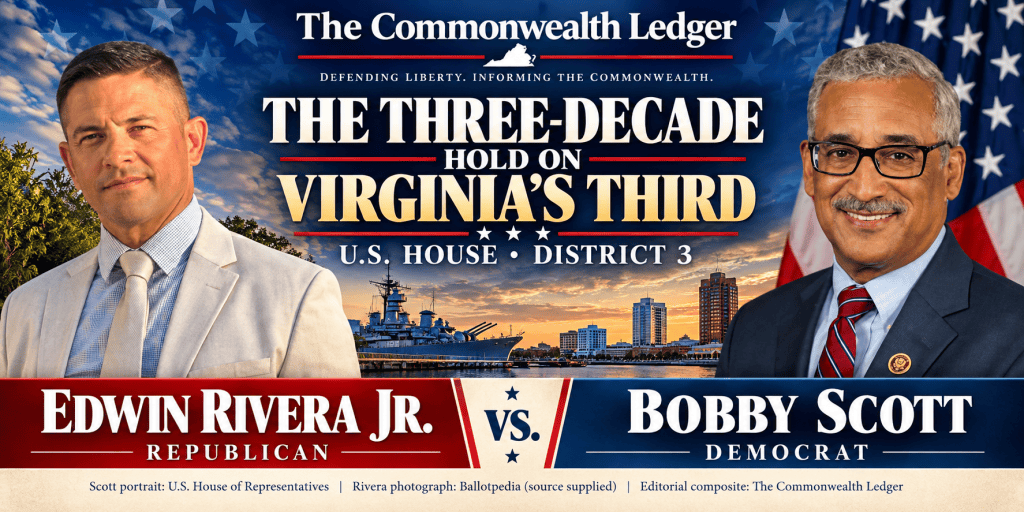
Bobby Scott Has Represented VA-3 Since 1993. Three Challengers Say It’s Time for a Different Direction.
By Michael Hevener
For more than three decades, one name has been nearly synonymous with Virginia’s 3rd Congressional District.
Bobby Scott.
The Newport News Democrat was first elected to Congress in 1992 and took office in January 1993.
Since then, presidents have come and gone, congressional majorities have changed repeatedly, district lines have been redrawn and American politics has transformed.
Through all of it, Bobby Scott has remained the district’s congressman.
Now 79, he is seeking another term against Republican Edwin Rivera Jr. and independents Makiba A. Gaines and Stephen C. Woll.
Unlike Virginia’s 1st and 2nd districts, there is little evidence that VA-3 is headed for a photo finish.
The Cook Political Report rates the district Solid Democratic and gives it a D+18 Partisan Voting Index.
In 2024, Scott defeated Republican John Sitka III approximately 70.0 percent to 29.8 percent, a margin of more than 40 percentage points.
That makes Scott the overwhelming favorite.
But elections are not only about predicting the winner.
They are also an opportunity to examine the incumbent’s record, consider the alternatives and ask whether decades of representation should automatically result in another term.
A DEMOCRATIC STRONGHOLD
Virginia’s 3rd District is centered in Hampton Roads and includes Newport News, Hampton, Portsmouth and Norfolk, along with a portion of Chesapeake.
It is one of the most reliably Democratic congressional districts in Virginia.
The district’s urban character, large Black electorate and strong Democratic performance in its major cities have created a political environment where Republican congressional candidates face an enormous structural disadvantage.
The numbers illustrate the challenge.
Scott received 219,926 votes in 2024 compared with 93,801 for Sitka.
Cook’s D+18 rating means the Republican nominee is not simply trying to defeat a longtime incumbent.
He is trying to overcome the underlying political composition of the district itself.
That distinction matters when evaluating the race.
An upset here would require something far beyond an ordinary Republican year.
BOBBY SCOTT
Scott’s longevity is remarkable even by congressional standards.
Before entering Congress, he served in the Virginia House of Delegates and Virginia Senate. He is a Harvard College and Boston College Law School graduate, practiced law in Newport News and founded the Peninsula Legal Aid Center.
He also served in the Massachusetts National Guard and U.S. Army Reserve.
In Congress, Scott has become particularly influential on education, labor, health care and criminal-justice policy.
He serves as the ranking Democrat on the House Committee on Education and the Workforce, marking his sixth term as the committee’s Democratic leader. He also serves on the House Budget Committee.
His supporters can make a straightforward argument for keeping him.
Few members of Congress possess his institutional experience.
He has spent decades working on issues involving education, workers, pensions, health care and criminal justice and has accumulated the committee seniority that comes with long service.
He has also developed a record of occasionally working across party lines.
Scott played a role in federal sentencing reform, including the Fair Sentencing Act, and later worked on bipartisan criminal-justice legislation, some provisions of which became part of the First Step Act signed by President Donald Trump.
For voters who value experience and congressional seniority, Scott offers both in abundance.
The question is whether experience accumulated over more than three decades remains enough.
EDWIN RIVERA
Republican Edwin Rivera Jr. offers voters a dramatically different biography.
Rivera describes himself as a grassroots conservative, former police officer, Army veteran and father.
According to his campaign, Rivera grew up in poverty and foster care before being raised by his grandparents in Puerto Rico.
He later worked as a police officer in Puerto Rico and joined the United States Army.
Rivera says he served multiple combat tours in the Middle East before retiring early as a disabled veteran.
His campaign emphasizes education reform, public safety, health-care access, veterans, youth development, Social Security, economic development and Second Amendment rights.
On education, Rivera says he wants better teacher support, expanded vocational and trade programs, safer schools and additional after-school opportunities.
His campaign also emphasizes support for law enforcement and stronger community institutions.
The contrast with Scott could hardly be sharper.
Scott offers more than three decades of congressional experience.
Rivera is asking voters to believe that the district needs a representative shaped more by military service, law enforcement and everyday family concerns than by more than three decades in Congress.
That can be an appealing argument.
But a challenger also has to demonstrate that he is prepared to govern.
And that is where Rivera still has work to do.
THE MONEY GAP
The financial difference between the two major-party candidates has been substantial.
Federal Election Commission reports through July 15 showed Scott with approximately $688,200 in receipts and about $191,843 in cash on hand.
Rivera reported approximately $6,555 in receipts and about $1,762 in cash on hand.
Those figures are a snapshot of the campaigns at that reporting point, not their current October finances. The next quarterly FEC reports, covering activity through September 30, are due October 15.
Even so, the July reports illustrated the scale of the challenge facing Rivera.
He is attempting to defeat one of Virginia’s longest-serving members of Congress in a D+18 district while operating with only a fraction of the incumbent’s financial resources.
Money does not determine every election.
But campaigns require mail, advertising, digital outreach, staff, voter contact and organization.
A candidate facing a structural disadvantage this large needs an exceptional campaign operation to overcome it.
TWO INDEPENDENTS
There are two additional choices on the ballot.
Makiba A. Gaines is a civil-rights attorney running as an independent.
Her campaign emphasizes affordability and presents her as an independent voice willing to challenge powerful political and economic interests rather than align automatically with either major party.
Stephen C. Woll is also running as an independent.
Woll is a Navy veteran, scientist and businessman who has lived in Hampton Roads for more than 25 years.
His campaign is built around dissatisfaction with the two-party system.
Woll argues that Washington has become more focused on partisan conflict than governing and says his scientific and business background would bring a problem-solving approach to Congress.
He has also demonstrated some ability to finance a campaign.
FEC reports through July 15 showed Woll with approximately $34,330 in receipts and $14,717 in cash on hand, although $20,000 of those receipts came from a candidate loan.
Neither independent is favored to win.
But their presence gives voters dissatisfied with both major parties alternatives and complicates the challenger vote in a district where anyone attempting to defeat Scott already faces extraordinarily difficult mathematics.
EDUCATION AND LABOR
Education and labor policy form the core of Scott’s congressional identity.
As the ranking Democrat on the House Education and the Workforce Committee, he has advocated increased federal investment in education, stronger worker protections, expanded access to health care and retirement security.
Scott has also supported student-debt relief and stronger federal protections against workplace discrimination.
His record reflects a fundamentally different philosophy of government from the one generally offered by Republicans.
Scott believes the federal government has an important role in protecting workers, expanding educational opportunity and providing a social safety net.
Rivera’s education message is less focused on Washington programs and more focused on schools themselves.
He emphasizes supporting teachers, career and technical education, safe learning environments and mentorship and after-school programs.
There is room for overlap between those ideas.
The deeper disagreement is likely to involve how much authority, spending and regulation should originate in Washington.
That is one area where Rivera’s responses to detailed policy questions would help voters understand exactly what a Rivera term in Congress would look like.
PUBLIC SAFETY AND THE SECOND AMENDMENT
Rivera’s background as a former police officer gives public safety a prominent place in his campaign.
He says communities need stronger support for law enforcement, crime prevention and accountability.
He is also an outspoken supporter of the Second Amendment and says responsible gun ownership is both a constitutional right and a responsibility.
Scott has taken a substantially different approach to firearms policy during his congressional career, generally supporting stronger federal gun restrictions and gun-safety legislation.
The philosophical divide is clear.
Rivera approaches the issue primarily from the standpoint of constitutional rights and law-abiding gun ownership.
Scott approaches it primarily through the federal government’s role in reducing gun violence and regulating access to firearms.
For voters concerned about both crime and constitutional rights, this is one of the clearest contrasts in the race.
HEALTH CARE
Health care is another major dividing line.
Scott has spent much of his congressional career defending and expanding federal health programs.
He supported the Affordable Care Act and has backed policies intended to expand insurance coverage, protect Medicaid and lower prescription-drug costs.
Rivera’s campaign says affordable health-care access for working families and seniors is a priority.
He also emphasizes protecting Social Security benefits and supporting veterans.
But broad goals are not the same thing as a legislative program.
Voters deserve to know how Rivera would approach Medicaid, Medicare, the Affordable Care Act, prescription-drug policy and the federal government’s role in health insurance.
Those questions are particularly important because a member of Congress does not vote on aspirations.
He votes on legislation.
IMMIGRATION
Scott has been sharply critical of the Trump administration’s immigration-enforcement policies and of Immigration and Customs Enforcement.
His position reflects the broader Democratic argument that immigration enforcement must be constrained by due process, civil rights and congressional oversight.
Republicans generally argue that the administration inherited a border and immigration system that required much stronger enforcement.
Rivera’s conservative political identity suggests substantial disagreement with Scott.
But suggestion is not enough for an election guide.
The Ledger wants Rivera’s own answers.
Would he support current federal enforcement policies?
What changes, if any, would he make?
What should happen to people living illegally in the United States?
What should Congress do about legal immigration?
Those distinctions matter.
DEFENSE, SHIPBUILDING AND HAMPTON ROADS
VA-3 sits in one of America’s most strategically important military regions.
Newport News Shipbuilding, Naval Station Norfolk and the broader defense economy make national-security policy directly relevant to thousands of families.
Scott has long represented those interests in Congress and has supported defense investments important to Hampton Roads.
Rivera’s Army combat experience gives him a personal connection to national security that deserves consideration.
Woll’s Navy background and career applying science and technology to military and strategic problems gives him another distinctive perspective.
This is one area where VA-3 voters have candidates with very different kinds of experience.
Scott brings congressional seniority.
Rivera brings combat and military experience.
Woll brings Navy, scientific and technical experience.
The question is how each would translate that background into votes on defense spending, shipbuilding, military readiness and America’s use of force overseas.
IRAN AND WAR POWERS
That last question is no longer theoretical.
Scott has been a vocal opponent of U.S. military operations against Iran initiated by President Trump without prior congressional authorization.
In March, he voted for a War Powers Resolution directing the termination of U.S. Armed Forces involvement in hostilities against Iran unless Congress authorized that involvement.
Scott argued that the military action lacked congressional authorization and that Congress must exercise its constitutional authority over war.
That establishes his position clearly.
The challengers deserve to be evaluated by the same standard.
Would Rivera have supported the War Powers Resolution?
Under what circumstances does he believe a president can initiate military action without prior congressional authorization?
How should the United States deal with Iran?
A combat veteran challenging a member of Congress on national-security issues should have the opportunity to answer those questions directly.
The Ledger has asked him to do so.
THIRTY-FOUR YEARS
There is another issue in this race that has nothing to do with a particular bill.
Time.
Scott has represented VA-3 since January 1993.
If reelected, he will begin another two-year term after more than 34 years in the House.
Supporters see that longevity as an asset.
Seniority brings influence, committee leadership, institutional knowledge and relationships that can benefit a district.
Critics see the same record differently.
They argue that more than three decades in the same congressional office raises legitimate questions about turnover, accountability and whether political power has become too entrenched.
Both arguments deserve consideration.
Longevity by itself is neither a qualification nor a disqualification.
The relevant question is what a member has done with the time.
Scott should not be reelected merely because he has held the seat since 1993.
Nor should he be rejected merely because he has.
His record should be judged.
And his challengers should be required to demonstrate that they offer something better.
THE LEDGER’S ANALYSIS
Bobby Scott enters this election with overwhelming structural advantages.
He represents a D+18 district.
He won approximately 70 percent of the vote two years ago.
He has substantially greater financial resources than his challengers, based on the latest reporting period available for this article.
He has represented Hampton Roads in Congress for more than three decades.
And he possesses committee seniority that no challenger could immediately replicate.
Pretending this is a toss-up would be misleading.
It is not.
Scott is the clear favorite.
But being the favorite does not settle the question of who deserves a voter’s support.
Rivera has a compelling personal story.
His experience in poverty, foster care, law enforcement, the Army, combat and family life gives him a perspective rarely found in Congress.
His emphasis on education, public safety, veterans and economic opportunity deserves attention.
But biography alone is not a governing agenda.
If Rivera wants voters to replace one of the longest-serving members of Congress, he needs to explain in detail what he would do differently.
Gaines and Woll also deserve consideration, particularly from voters dissatisfied with the two-party system.
Gaines brings a civil-rights legal background and an explicitly independent political message.
Woll brings military, scientific and business experience.
Neither should be dismissed simply because the political system makes independent candidacies extraordinarily difficult.
THE ENDORSEMENT QUESTION
The Commonwealth Ledger is not making an endorsement in VA-3 at this time.
That is intentional.
Before recommending that voters replace a 34-year incumbent, we want enough information about the alternatives to make that recommendation responsibly.
As the Republican nominee and principal major-party challenger, Edwin Rivera has been asked by The Commonwealth Ledger to answer a candidate questionnaire addressing the issues voters would entrust him to decide in Congress.
We want his positions on federal spending and debt.
We want his position on abortion.
We want his approach to immigration and border enforcement.
We want specifics on health care.
We want to know his view of U.S. military operations against Iran and the constitutional division of war powers between Congress and the president.
And because Virginia voters will also decide three proposed constitutional amendments this November, we want to know where he stands on those questions.
Scott has a record spanning more than three decades.
Voters can examine it.
Rivera is asking them to choose a different direction.
Before The Commonwealth Ledger recommends that they do so, we want his answers on the issues he would actually face in Congress.
Party affiliation tells us something.
It does not tell us enough.
We will give Rivera the opportunity to answer.
Then we will make our choice.





Leave a Reply