By Michael Hevener
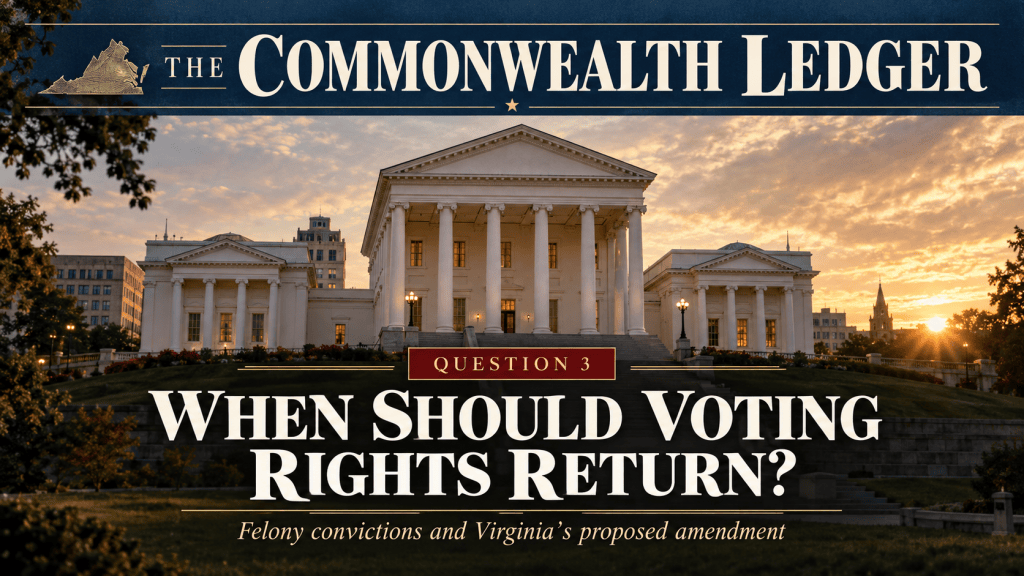
WHEN SHOULD VOTING RIGHTS RETURN AFTER A FELONY CONVICTION?
After a 2026 federal court ruling, Virginia’s felony voting rules have changed. State guidance now bars registration for three statutory offenses; Question 3 would put a release-based restoration rule in the Constitution, while its interaction with federal law remains important to the debate.
When should a person convicted of a felony regain the right to vote?
When incarceration ends?
When probation and parole are completed?
Or after a separate restoration process?
Question 3 answers that question for Virginia:
When the person is released from incarceration for the felony conviction.
Virginia’s Constitution still says that a person convicted of a felony is not qualified to vote unless civil rights have been restored. A federal court ruling now limits how the Commonwealth may enforce that provision.
Question 3 would replace that constitutional rule.
A person convicted of a felony would be unable to vote during incarceration for that felony. Upon release from incarceration for the felony conviction, political rights, including voting, would be restored automatically.
Completion of probation would not be required.
Completion of parole would not be required.
A separate restoration decision would not be required.
And the constitutional restoration rule would not distinguish between violent and nonviolent felonies.
Question 3 also makes two additional constitutional changes.
It expressly declares voting a “fundamental right” and replaces Virginia’s existing mental-competency language with a voting-specific capacity standard.
There is more on this ballot than the phrase “felon voting rights” suggests.
WHAT QUESTION 3 ACTUALLY SAYS
The proposed amendment would rewrite Article II, §1 of the Virginia Constitution.
It begins by declaring that every person meeting Virginia’s voter qualifications has the:
“fundamental right to vote in the Commonwealth”
and provides that the right may not be abridged by law except for the limitations contained in the provision.
For people convicted of felonies, the amendment establishes a new constitutional rule.
A person convicted of a felony would not be entitled to vote:
“during any period of incarceration for such felony conviction.”
Then comes the critical language.
Upon release from incarceration for that felony conviction, the person would, without further action required of him, be invested with all political rights, including the right to vote.
The constitutional trigger is therefore:
RELEASE FROM INCARCERATION FOR THE FELONY CONVICTION.
Not completion of probation.
Not completion of parole.
Not an individualized gubernatorial restoration decision.
Release.
CURRENT LAW AND QUESTION 3
In King v. Youngkin, a federal district court held that the Virginia Readmission Act limits disenfranchisement to felonies that existed at common law in 1870. Its August 2026 enforcement order directed Virginia not to deny registration or cancel registration for other convictions.
The Virginia Department of Elections’ current guidance identifies three statutory offenses that disqualify a person from registering: murder, voluntary manslaughter and involuntary manslaughter. It also says people physically incarcerated for any felony cannot register or vote. After release, people with other felony convictions may register without gubernatorial restoration, subject to ordinary voter qualifications. The federal court has not decided whether federal law permits the incarceration restriction.
The court did not decide whether incarceration itself may be a basis to deny voting rights. It also said a state constitutional amendment would not override the federal limits in the Readmission Act.
TODAY
CURRENT DEPARTMENT GUIDANCE
↓
PHYSICALLY INCARCERATED FOR ANY FELONY: CANNOT REGISTER OR VOTE
↓
AFTER RELEASE: THREE STATUTORY OFFENSES STILL DISQUALIFY
↓
OTHERS MAY REGISTER UNDER COURT ORDER
QUESTION 3
FELONY CONVICTION
↓
NO VOTING DURING INCARCERATION
↓
RELEASE FROM INCARCERATION FOR THE FELONY CONVICTION
↓
POLITICAL RIGHTS AUTOMATICALLY RESTORED
For the three offenses that remain disqualifying under current state guidance, that is the central change Question 3 proposes.
THE CASE FOR QUESTION 3
Supporters make a serious argument.
A Virginian whom the Commonwealth has released back into society may be expected to work, pay taxes, raise a family, obey the law and fulfill the responsibilities of citizenship.
For people still disqualified under current state guidance, supporters ask why voting eligibility should continue to depend on a restoration decision after incarceration ends.
They argue that civic participation can support successful reentry for people who remain ineligible after release.
There is also an argument about fairness and consistency.
For the three offenses that current state guidance says remain disqualifying, voting rights generally depend on gubernatorial restoration.
Supporters argue that eligibility for those individuals should not depend upon the philosophy of whichever governor occupies the Executive Mansion.
Question 3’s text instead sets out one constitutional rule:
Incarcerated for a felony: no vote.
Released from incarceration for the felony conviction: rights restored.
Supporters also argue that the severity of the crime has already been addressed through the criminal sentence.
Someone convicted of a grave violent offense may remain incarcerated for decades. Someone convicted of a less serious offense may be released much sooner.
Once the Commonwealth releases someone back into society, supporters argue, the same citizenship rule should apply.
And there is another argument that deserves to be taken seriously.
Virginia’s history includes significant racial discrimination in voting.
THE JIM CROW ARGUMENT
Supporters of Question 3 frequently connect felony disenfranchisement with Virginia’s history of racial discrimination.
There is substantial history behind that argument.
But precision matters.
Virginia’s history of criminal disenfranchisement is older than Jim Crow.
The Commonwealth restricted voting for felony convictions long before the Constitution of 1902.
But that is not the entire history.
During the post-Reconstruction era, Virginia expanded voting restrictions involving criminal convictions as part of a broader political system that deliberately sought to suppress Black political participation.
The Constitutional Convention of 1901-1902 then imposed additional voting restrictions, including poll taxes and registration barriers, as part of an openly discriminatory effort to dramatically reduce Black political power.
Library of Virginia figures show that in the 1904 presidential election, Black voter participation fell 90 percent from the previous presidential election; white participation fell 50 percent.
Many white Virginians were disenfranchised as well.
The racial purpose behind important elements of that system is part of Virginia’s historical record and should neither be exaggerated nor minimized.
Supporters argue that Question 3 offers Virginia an opportunity to move decisively away from that history.
Their alternative is simple and race-neutral:
Incarcerated for a felony: no vote.
Released from incarceration for the felony conviction: rights restored.
That is a legitimate argument for Question 3.
HISTORY DOES NOT SETTLE THE POLICY QUESTION
That record remains relevant to today’s debate over voting-rights restoration.
But acknowledging that history does not determine which restoration standard Virginia must adopt today.
The voting restrictions of the Jim Crow era are not what voters are being asked to approve or reject in 2026.
The question before them is what restoration rule Virginia should use now.
A voter can acknowledge Virginia’s history of racial discrimination while believing restoration should occur after probation or parole is completed.
A voter can reject arbitrary barriers to voting while opposing automatic restoration.
A voter can support an objective, race-neutral restoration process.
And a voter can believe the nature of the felony is a legitimate consideration in determining when political rights should return.
History matters.
But history does not eliminate the need to debate the constitutional language before voters.
RESTORATION vs. AUTOMATIC RESTORATION
This is the heart of the disagreement.
The question is not whether someone convicted of a felony should ever be permitted to vote again.
Virginia already has restoration pathways. Under current guidance, many released people with felony convictions may register without gubernatorial restoration.
The question is whether the Constitution should set release from incarceration as the restoration point for the three offenses that remain disqualifying, while adding a new incarceration restriction whose federal-law status the court has not decided.
Those are different positions.
A person may leave incarceration while still remaining under probation, parole or other court-ordered supervision.
For the three offenses that remain disqualifying under state guidance, Question 3 would make release from incarceration the constitutional restoration point.
Supporters believe that is the appropriate line.
Opponents may believe completion of probation, parole or another objective restoration standard should come first.
Question 3 resolves that disagreement constitutionally.
For those offenses, it chooses release from incarceration as the constitutional restoration point.
NO INDIVIDUAL RESTORATION DECISION
The amendment says restoration occurs:
“without further action required of him.”
The person would not have to obtain an individualized gubernatorial restoration decision.
The Constitution itself would restore political rights upon release from incarceration for the felony conviction.
Supporters argue this removes politics and executive discretion from what they consider a fundamental constitutional right.
Opponents can agree that restoration should not depend upon partisan politics while rejecting automatic restoration as the only alternative.
Virginia could establish objective restoration standards.
It could create a uniform process.
It could remove unnecessary gubernatorial discretion.
And it could provide a clear path back to the ballot.
Question 3 instead writes automatic restoration upon release directly into the Constitution.
VIOLENT AND NONVIOLENT FELONIES
Question 3 establishes the same constitutional restoration trigger regardless of whether the underlying felony was violent or nonviolent.
The severity of the crime would still affect the criminal sentence and therefore potentially how long the person remains incarcerated.
But it would not create a different constitutional restoration standard after release.
Supporters argue that is appropriate.
The criminal-justice system already imposes different punishments for different crimes. Once incarceration ends, they argue, political rights should return under the same rule.
Opponents may believe the nature of the offense remains a legitimate consideration when restoring political rights.
Virginia’s statutory court-petition process applies only to eligible petitioners. It is a separate restoration route and does not describe the current process for every person whose registration remains disqualified under state guidance.
The statute excludes certain violent felonies, specified drug felonies and an election-related felony from that particular process.
For eligible petitioners, the statute generally requires completion of the sentence and its modifications, including probation and parole, at least five years earlier. It also requires no criminal convictions, excluding traffic infractions, during that period, along with evidence of civic responsibility through community or comparable service.
A favorable court order is forwarded to the Governor, who retains authority to approve or deny restoration under this petition process.
This statutory court-petition procedure is not the entirety of the Governor’s constitutional restoration authority.
But it illustrates an important point:
This process shows that Virginia law can consider offense type and post-sentence conduct in deciding restoration for people eligible to use it. The Department of Elections says the three offenses that currently disqualify require gubernatorial restoration.
Question 3 establishes a different constitutional rule.
VIRGINIA’S CURRENT STATUTORY COURT-PETITION PROCESS
For eligible offenders, one current statutory court-petition process generally includes:
- Completion of the sentence, including probation and parole
- Five years following completion of the sentence and its modifications
- No criminal convictions, excluding traffic infractions, during the required period
- Demonstrated civic responsibility through community or comparable service
- Circuit-court review
- Final gubernatorial approval or denial
Certain violent felonies, specified drug felonies and an election-related felony are excluded from this particular process.
This is not the only avenue through which gubernatorial restoration authority may operate.
Now compare that process with Question 3:
QUESTION 3
RELEASE FROM INCARCERATION FOR THE FELONY CONVICTION
↓
POLITICAL RIGHTS RESTORED
↓
NO INDIVIDUAL RESTORATION DECISION REQUIRED
That is a substantial change.
WHAT ABOUT PROBATION AND PAROLE?
Does Question 3 require completion of probation before political rights return?
No.
Does it require completion of parole?
No.
Does it require an individual restoration application?
No.
Does it require an individualized gubernatorial restoration decision?
No.
The constitutional restoration trigger is release from incarceration for the felony conviction.
The General Assembly’s contingent implementing legislation reinforces that distinction.
Under that legislation, a person sentenced to incarceration for a felony becomes eligible for restoration upon release from incarceration. The legislation does not condition restoration on completion of probation or parole.
That contrast is significant because Virginia’s existing statutory court-petition process expressly refers to completion of probation and parole when establishing eligibility under that process.
Virginia lawmakers therefore know how to require completion of probation and parole.
Question 3 does not do so.
That may be exactly what some Virginians want.
Others may consider it too soon.
But voters should understand the choice.
A “FUNDAMENTAL RIGHT TO VOTE”
Question 3 does something else.
It expressly declares a:
“fundamental right to vote in the Commonwealth.”
That phrase does not appear in the current Article II, §1.
The important question is not whether those words sound appealing.
It is:
WHAT LEGAL WORK WILL THOSE WORDS DO?
Placing a fundamental right to vote expressly into Virginia’s Constitution would provide constitutional language against which future voting restrictions could be challenged.
But the phrase should not be exaggerated.
Question 3 retains voter qualifications.
Citizenship remains required.
The minimum voting age remains.
Residency remains.
Registration remains.
Question 3’s text would bar voting during any period of incarceration for the felony. The federal court has not decided whether the Readmission Act permits that restriction, and its order says the amendment cannot override federal law.
And the amendment retains a judicial process involving people who lack the capacity to understand the act of voting.
So Question 3 does not mean every election regulation becomes unconstitutional.
But “fundamental right” would become new constitutional language.
Its application to future disputes would depend upon the law being challenged and how Virginia courts interpret the amended Constitution.
Voters should understand that before approving it.
ANOTHER CHANGE: MENTAL CAPACITY AND VOTING
Question 3 also changes a provision that has received considerably less public attention.
Virginia’s current Constitution says that, as prescribed by law, a person adjudicated “mentally incompetent” is not qualified to vote until competency has been reestablished.
Question 3 replaces that language.
Under the amendment, voting eligibility could be denied to a person adjudicated by a court of competent jurisdiction to:
“lack the capacity to understand the act of voting.”
That restriction would continue during the period of incapacity until capacity was reestablished as prescribed by law.
Supporters can make a reasonable argument for this change.
“Mentally incompetent” is a broad classification.
The proposed language focuses specifically upon the capacity relevant to voting: whether someone understands the act of voting.
Virginia law already provides additional safeguards for this determination. A court must find by clear and convincing evidence that the person lacks the capacity to understand the act of voting. If the determination relies on a guardian ad litem’s report, evidence must show that reasonable accommodations appropriate to the person’s condition were provided in assessing that capacity.
Opponents should not claim Question 3 simply permits everyone with severe mental incapacity to vote.
It does not.
It changes the constitutional standard.
That deserves attention because Question 3 is broader than felony restoration alone.
VIRGINIA HAS ALREADY PREPARED FOR THE CHANGE
The General Assembly has already enacted statutory machinery for automatic restoration, contingent upon the constitutional change taking effect.
The legislation follows the amendment’s basic structure.
A person convicted of a felony and sentenced to incarceration would be unable to register or vote during incarceration.
Upon release from incarceration for the felony conviction, political rights lost because of the felony conviction would be restored and the person could become eligible to register.
Virginia has also enacted contingent procedures for correctional officials to transmit release information to election officials so the voter-registration system can be updated.
The implementing legislation provides a process for resolving cases in which the voter-registration system still reflects a released person as ineligible.
Lawmakers have therefore done more than propose a constitutional principle.
They have enacted the statutory framework designed to implement automatic restoration if the constitutional amendment takes effect.
WHAT QUESTION 3 DOES NOT DO
Precision works both ways.
Question 3 does not permit people incarcerated for felony convictions to vote during that incarceration.
It does not eliminate voter registration.
It does not eliminate citizenship or residency requirements.
It does not lower the voting age.
It does not eliminate every restriction involving mental capacity.
And it does not mean every voting regulation becomes unconstitutional simply because voting is expressly called a fundamental right.
Nor does “automatic restoration” mean election administration disappears or that ordinary voter qualifications cease to apply.
For the three offenses that remain disqualifying under current state guidance, Question 3 would remove the need for an individualized restoration decision after release. For people convicted of other felonies, released Virginians may already register under the court order and current Department guidance.
The case against Question 3 does not require exaggeration.
The changes actually contained in the amendment are significant enough to debate on their own.
THE REAL CHOICE BEFORE VIRGINIA
Question 3 should not be reduced to:
“Should felons vote?”
That misses the central issue.
The real question is:
WHEN SHOULD POLITICAL RIGHTS RETURN?
The Commonwealth Ledger does not believe restoration should depend upon the political philosophy of a governor.
Nor do we believe a felony conviction should necessarily mean permanent disenfranchisement.
Virginia should have a clear, objective and race-neutral path for restoring voting rights.
Should the Constitution make restoration automatic upon release for the three offenses that remain disqualifying under state guidance, while federal courts have left the incarceration question unresolved?
Should Virginia be permitted to consider the nature of an offense when establishing restoration standards?
Should voting expressly become a “fundamental right” under the Virginia Constitution?
Should the existing mental-competency provision be replaced by a voting-specific capacity standard?
Those are the questions Virginians are actually deciding.
THE COMMONWEALTH LEDGER’S VIEW
Virginia’s history of racial discrimination in voting should remind us to oppose arbitrary barriers to the ballot.
It should also teach us to write constitutional rules carefully.
The Commonwealth Ledger believes voting rights should be restorable after a felony conviction.
We believe in second chances.
We believe in redemption.
And we do not believe the political rights of Virginians should depend upon the partisan philosophy of whichever governor happens to hold office.
Virginia should have a uniform, objective and race-neutral restoration system.
Such a system could remove unnecessary gubernatorial discretion, establish clear standards and provide a predictable path back to the ballot.
It could recognize completion of probation or parole and demonstrated rehabilitation as considerations for people who remain subject to a restoration process.
Question 3 chooses a different approach.
It constitutionalizes one rule:
For the three offenses still disqualifying under current state guidance, release from incarceration would trigger restoration under the amendment’s text.
That rule applies even if probation or parole continues.
The amendment’s text sets one restoration rule regardless of whether the underlying felony was violent or nonviolent; its effect remains subject to federal law.
For those three offenses, the amendment would remove an individualized gubernatorial restoration decision after release.
Supporters consider those features virtues.
The Commonwealth Ledger considers them a step too far.
That history should inform this debate, but it does not decide which restoration standard Virginia should adopt today.
It does not require us to conclude that release from incarceration should settle every restoration case, especially while the amendment’s application remains subject to federal law.
Virginia can confront the racial discrimination of its past while providing a fair path back to the ballot.
It can believe in redemption while still believing accountability matters.
The Commonwealth Ledger supports restoration.
We oppose making release from incarceration the only constitutional restoration trigger for the three offenses that remain disqualifying under current state guidance.
THE COMMONWEALTH LEDGER RECOMMENDS
VOTE NO ON QUESTION 3
Virginia should maintain a fair, objective and race-neutral path to restoration for the three offenses that remain disqualifying under current state guidance.
For those offenses, we believe release from incarceration should not, by itself, settle every case.
Second chances matter.
Accountability matters too.
Sources and Further Reading: 2026 SB 6, proposed amendment to Article II, §1; Virginia Constitution, Article II, §1; King v. Youngkin, January 2026 opinion; King v. Youngkin, August 2026 enforcement order; Virginia Department of Elections, felony convictions and voter eligibility; Virginia Code §53.1-231.2; Virginia Code §24.2-400.1; Virginia Code §64.2-2009.2; Library of Virginia, “Voting Rights and the Virginia Constitution of 1902”.