
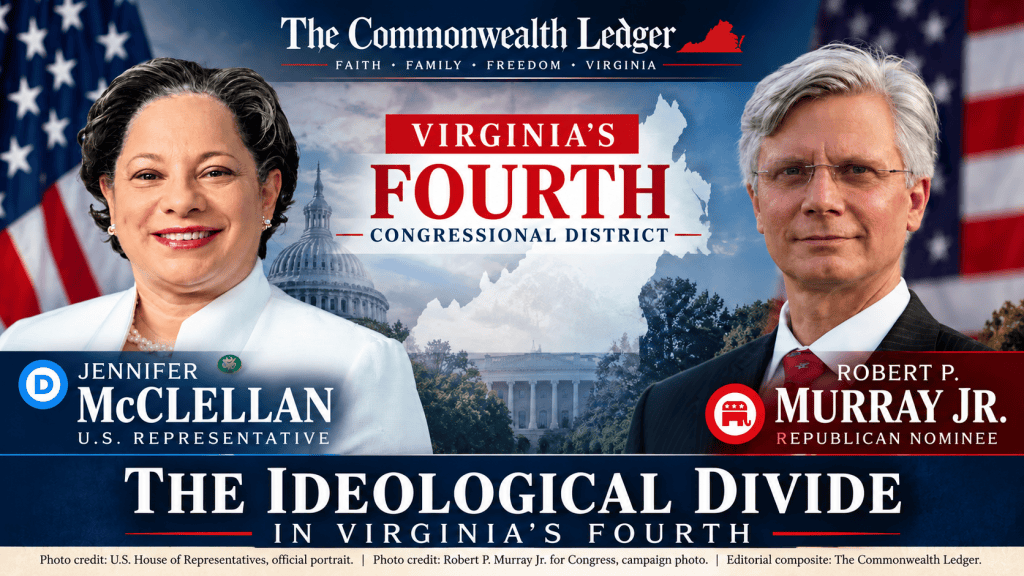
Jennifer McClellan Holds One of Virginia’s Safest Democratic Seats. Robert Murray Says the District Needs a Fundamentally Different Direction.
By Michael Hevener
Virginia’s 4th Congressional District is not expected to be one of the Commonwealth’s closest elections.
It may, however, be one of its clearest ideological choices.
Democratic Congresswoman Jennifer McClellan is seeking another term against Republican Robert P. “Family Man” Murray Jr.
and independent Joan E. “Andrews” Bell.
McClellan enters the race with enormous structural advantages.
The Cook Political Report rates VA-4 Solid Democratic and gives the district a D+17 Partisan Voting Index.
In 2024, McClellan received 252,885 votes, approximately 67.3 percent, against Republican Bill Moher’s 121,814 votes, approximately 32.4 percent.
This is not a toss-up.
It is not even particularly close on paper.
But elections are not merely exercises in calculating probabilities.
They are choices about representation.
And in Virginia’s 4th District, the differences between the leading candidates are substantial.
A DEEPLY DEMOCRATIC DISTRICT
Virginia’s 4th stretches from the Richmond metropolitan area into Southside Virginia.
Its political center of gravity is heavily Democratic.
Kamala Harris carried the district by approximately 33 points in 2024, and McClellan won her congressional race by nearly 35 points.
That gives the incumbent an advantage that goes well beyond fundraising, name recognition or campaign organization.
The district itself favors Democrats.
For Murray to win, he would need to persuade a significant number of voters who normally support Democratic candidates to reconsider not merely their congresswoman, but their political habits.
That is an extraordinary challenge.
The question, therefore, is not whether McClellan begins as the favorite.
She unquestionably does.
The more important question for voters is what she has done with that advantage and whether Murray or Bell offers a compelling reason to choose a different direction.
JENNIFER McCLELLAN McClellan entered Congress in 2023 after winning the special election following the death of Congressman Donald McEachin.
Her election was historic.
She became the first Black woman elected to Congress from Virginia.
But McClellan was hardly new to politics.
Before entering Congress, she spent years in the Virginia General Assembly, serving in both the House of Delegates and the state Senate.
Her political identity has been shaped by issues including abortion rights, voting rights, health care, environmental policy, education and civil rights.
In Congress, she serves on the House Committee on Energy and Commerce, placing her in the middle of debates involving health care, energy, telecommunications, technology and environmental policy.
McClellan presents herself as an advocate for families facing rising costs while arguing that government has an important role in expanding health coverage, protecting reproductive rights, regulating major industries and assisting working families.
Her supporters see an experienced legislator with a clear understanding of both Richmond and Washington.
Her critics see something else.
They see a reliably progressive member of Congress representing a district where the Democratic advantage provides relatively little electoral pressure from the political center.
That distinction matters.
Safe districts can give members of Congress the freedom to vote according to their convictions.
They can also reduce the political consequences of ideological excess.
Voters must decide which description better fits McClellan.
ROBERT “FAMILY MAN” MURRAY
Murray offers a dramatically different philosophy.
His campaign is built around fiscal reform, affordability, civil liberties, reducing America’s overseas commitments and restructuring parts of the federal government.
Murray argues that inflation and federal fiscal policy are fundamental threats to American families.
His economic proposals are unconventional and ambitious.
He has called for changes to the Federal Reserve’s mandates and the federal funding system, major changes to taxation, reduced overseas military expenditures, deregulation intended to increase housing construction and greater use of technology to reduce waste and inefficiency.
Some voters will find those ideas refreshing.
Others may question whether proposals this sweeping are politically or economically achievable.
That is a legitimate question.
A challenger should not receive a pass merely because he opposes the incumbent.
But Murray deserves credit for offering voters considerably more than slogans.
He has articulated specific views about federal spending, monetary policy, housing, artificial intelligence, surveillance, immigration, foreign policy and Virginia’s constitutional amendments.
The result is an unusually sharp contrast.
THE MONEY GAP
The financial disparity in this race also illustrates the challenge facing McClellan’s opponents.
Federal Election Commission records covering January 1, 2025 through July 15, 2026 showed McClellan with approximately $1.14 million in receipts and about $197,400 in cash on hand.
Her campaign also reported approximately $607,800 in contributions from other committees during that period.
Comparable summary figures for Murray were not displayed in the FEC candidate summary reviewed for this article. His principal campaign committee is Virginia Lovers for Robert Murray.
That should not be interpreted to mean Murray raised no money.
It means comparable FEC summary data were not available from the candidate summary reviewed.
What can be said with confidence is that McClellan entered the latter part of the campaign with a substantial federally reported fundraising operation behind her.
In a district that already strongly favors Democrats, that adds another obstacle for a challenger attempting to change the political equation.
AFFORDABILITY
Both McClellan and Murray say affordability is a central concern.
Their diagnoses are very different.
McClellan argues that Trump administration tariffs, reductions in federal health and food assistance and the expiration of enhanced Affordable Care Act subsidies have increased financial pressure on families.
She advocates restoring health-care subsidies, investing in clean and renewable energy, expanding support for families and requiring data centers and other large electricity users to bear more of the costs associated with their energy demands.
Murray places much greater emphasis on inflation, monetary policy, taxation and federal debt.
He argues that Washington’s financial system has weakened the purchasing power of American families and that simply manipulating interest rates cannot solve the underlying problem.
On housing, Murray favors deregulation intended to accelerate construction.
He also proposes significant changes to the tax system, including eliminating the individual income-tax mandate and shifting more of the tax burden toward corporations and overseas suppliers.
These are not small disagreements over the details of federal policy.
They represent competing theories of government.
McClellan generally sees federal investment, subsidies and regulation as tools that can make life more affordable.
Murray argues that government spending, monetary policy, taxation and regulation are themselves major contributors to the problem.
VA-4 voters have a genuine choice between those philosophies.
DATA CENTERS AND ENERGY
Few issues are becoming more important in Virginia than the enormous growth of data centers and the electricity infrastructure required to support them.
McClellan argues that households and small businesses should not be forced to subsidize the infrastructure necessary to serve massive data-center loads.
She has cosponsored federal legislation addressing those concerns, including the Ratepayer Protection Act, the Load Forecasting Enhancement Act and the Power to the People Act.
In September, the House passed four bills she cosponsored addressing electricity demand and costs associated with data-center growth.
That gives McClellan a developed federal legislative record on an issue of growing importance to Virginia ratepayers.
Murray takes a broader regulatory approach.
He argues that Congress can use its interstate-commerce authority to address energy and pollution issues and says data centers should be located where communities want them and where they can operate responsibly.
His position is less developed legislatively than McClellan’s.
For voters concerned about rapidly increasing electricity demand, infrastructure costs and Virginia’s changing landscape, the issue deserves careful examination.
ABORTION
Few contrasts in this race are clearer.
McClellan has spent much of her political career advocating abortion rights.
As a Virginia legislator, she helped advance legislation removing restrictions on abortion and supported adding reproductive-rights protections to the Virginia Constitution.
In Congress, she continues to advocate federal protection of abortion rights.
Murray says abortion should remain primarily a state issue following the Supreme Court’s Dobbs decision.
He combines a personal belief that life begins at conception with the position that abortion policy should remain primarily with the states.
For voters who consider abortion one of the most important issues in the election, the difference between the candidates is unmistakable.
HEALTH CARE
McClellan’s approach to health care reflects her broader belief in an active federal role.
She has defended Medicaid expansion, opposed reductions in Medicaid spending and supported restoring enhanced Affordable Care Act premium subsidies.
She argues that federal reductions in health spending threaten patients, clinics and hospitals, particularly providers operating with narrow financial margins.
Murray emphasizes prevention, nutrition, exercise, technology and reducing waste, fraud and abuse within the health-care system.
He argues that America’s health system has become too focused on expensive treatment rather than preventing disease.
Again, there is some common ground in the stated goal.
Both candidates want healthier people and more affordable care.
But their approaches diverge sharply over the role Washington should play in achieving it.
IMMIGRATION AND THE ROLE OF GOVERNMENT
Murray’s affordability argument is also tied to immigration.
He says the United States should welcome legal immigrants who want to assimilate and contribute while opposing taxpayer support for people living in the country illegally.
He argues that immigration policy affects housing, taxes and the broader economy.
McClellan supports enforcing immigration laws while calling for a humane approach to border security, a path to citizenship for some undocumented immigrants and greater accountability and limits on federal immigration enforcement.
That divide mirrors one of the central national political arguments of 2026.
How much emphasis should the federal government place on enforcement?
What obligations does the country have toward people already living here illegally?
How should legal immigration be structured?
And what rights should apply when federal immigration authorities exercise their power?
VA-4 voters are choosing between candidates who approach those questions from very different starting points.
PRIVACY AND GOVERNMENT SURVEILLANCE
One of the more interesting areas of partial agreement involves automatic license-plate readers and mass surveillance.
Both candidates express concerns about civil liberties.
McClellan says technology can be useful in legitimate investigations but must comply with constitutional protections, particularly the Fourth Amendment.
Murray goes further.
He argues that systems such as Flock and similar license-plate-reader networks are frequently misused and can allow government to circumvent restrictions on warrantless surveillance.
He says the civil-liberties risks currently outweigh the benefits unless the technology is properly governed.
This is an example of an issue where partisan labels do not tell the entire story.
Both candidates recognize a legitimate law-enforcement use for technology.
Both also acknowledge that government surveillance can become a threat to individual liberty.
The disagreement is more about where the presumption should lie.
FOREIGN POLICY
Murray also separates himself from traditional Republican foreign-policy orthodoxy.
He argues that the United States should reduce overseas military expenditures and focus more resources on domestic infrastructure, economic stability and national defense at home.
On Israel, he supports Israel’s right to self-defense but favors reducing American military assistance.
McClellan supports the longstanding U.S.-Israel alliance while arguing that Israel must comply with international humanitarian law.
She supports a two-state solution and continued American involvement in negotiations intended to end regional hostilities and address the humanitarian crisis in Gaza.
Once again, voters are not being offered a simple partisan stereotype.
Murray’s foreign-policy argument is more restrained and focused on reducing American commitments abroad.
McClellan supports a more traditional American diplomatic role while placing conditions and humanitarian expectations on U.S.
allies.
THREE AMENDMENTS, THREE CLEAR DIFFERENCES
Virginia’s three proposed constitutional amendments provide perhaps the cleanest comparison between McClellan and Murray.
McClellan supports all three.
Murray opposes all three.
On Question 1, McClellan strongly supports adding reproductive-freedom protections to Virginia’s Constitution and says reproductive decisions should remain between individuals and their medical providers rather than politicians.
Murray says Virginians should vote no.
On Question 2, McClellan supports constitutional protection for marriage regardless of sex, gender or race and argues that Virginia should remove discriminatory language made unenforceable by Supreme Court decisions.
Murray opposes the amendment.
He says he accepts same-sex relationships and believes adults have the right to associate with whomever they choose, but argues that the amendment creates unnecessary risks involving religious liberty, service providers and the legal distinction between sex and gender.
On Question 3, McClellan supports the proposed constitutional change that would establish voting as a fundamental right, automatically restore voting rights after a person convicted of a felony is released from incarceration and revise Virginia’s constitutional language concerning mental capacity and voting.
Murray again says vote no.
His stated objection includes concern about the amendment’s treatment of mental capacity.
The Commonwealth Ledger opposes all three amendments.
But McClellan’s position should be represented accurately.
She is not concealing her views.
She strongly supports the amendments and says she will campaign for them.
Murray is equally clear in opposition.
For voters who consider the constitutional amendments important, there is no ambiguity between the two major-party candidates.
JOAN E. “ANDREWS” BELL
Independent Joan E. “Andrews” Bell gives voters a third option.
Bell’s campaign is particularly associated with opposition to Question 1 and opposition to later-term abortion.
Her presence matters because some voters who are dissatisfied with McClellan may also be unwilling to support Murray.
Independent candidates face enormous obstacles in congressional elections, especially in districts dominated by one political party.
Bell is not positioned as the likely winner.
But election guides should not treat ballot access as decorative.
A candidate who qualifies for the ballot deserves to be examined.
Bell has not provided the same level of publicly available policy detail as McClellan and Murray, and she did not provide answers to the candidate questionnaire used for several comparisons in this article.
That limits how extensively we can evaluate her candidacy.
The Ledger will not fill those gaps with assumptions or attribute positions to Bell that she has not established publicly.
THE REALITY OF THE RACE
The electoral mathematics are brutal for Murray.
A D+17 district does not become competitive merely because Republicans nominate an energetic candidate.
McClellan won more than two-thirds of the vote in 2024.
The district’s political geography heavily favors Democrats.
Murray therefore needs more than Republican turnout.
He needs persuasion.
He must convince independents and a meaningful number of Democratic voters that McClellan’s philosophy of government does not serve their interests.
That is a difficult task.
But difficulty should not be confused with irrelevance.
Safe congressional districts still deserve competitive ideas.
Incumbents still deserve scrutiny.
And voters still deserve alternatives.
THE LEDGER’S ANALYSIS
Jennifer McClellan is the overwhelming favorite to win Virginia’s 4th District.
Any responsible analysis must begin there.
She has political experience, a substantial legislative record and positions that closely align with the electorate that has repeatedly elected Democrats in this district.
She is also unusually clear about what she believes.
On abortion, health care, energy, voting rights, marriage and the role of the federal government, voters do not have to guess.
That clarity deserves respect even where The Commonwealth Ledger disagrees with her conclusions.
Murray also offers voters something increasingly rare in congressional politics.
He is willing to challenge assumptions within his own party.
His positions on monetary policy, foreign intervention, government surveillance and taxation are not simply repetitions of national Republican talking points.
Some of his proposals require much greater scrutiny.
Some would face enormous political obstacles.
And some may prove impractical.
But he is presenting an identifiable philosophy of government built around fiscal restraint, decentralization, civil liberties, family stability and reduced federal intervention.
The district’s political composition makes his path extraordinarily difficult.
That does not make his arguments unworthy of consideration.
THE LEDGER’S CHOICE
The Commonwealth Ledger approaches endorsements with a simple standard.
Party affiliation matters because political parties represent broad governing philosophies.
But party affiliation alone is not enough.
Candidates should be judged by what they say, what they have done and what they propose to do with the authority voters give them.
Jennifer McClellan has been clear about her governing philosophy.
The Ledger disagrees with much of it.
We believe federal spending and debt require greater restraint.
We believe individual liberty deserves stronger protection against expanding government power.
We believe abortion policy should provide greater protection for unborn life.
We believe the growth of the administrative state requires skepticism rather than automatic expansion.
And on the three constitutional amendments Virginia voters will decide this November, McClellan supports all three while Murray opposes all three.
Murray is not a conventional candidate, and voters should examine his more ambitious proposals carefully.
An endorsement is not a declaration that a candidate is flawless.
It is a judgment about which candidate, among the choices actually before voters, offers the better direction.
In Virginia’s 4th District, we believe that candidate is Robert P. “Family Man” Murray Jr.
The electoral odds are unquestionably against him.
Our judgment is not based on the odds.
It is based on the choice.
For Virginia’s 4th Congressional District, our choice is Robert P. “Family Man” Murray Jr.


Leave a Reply