
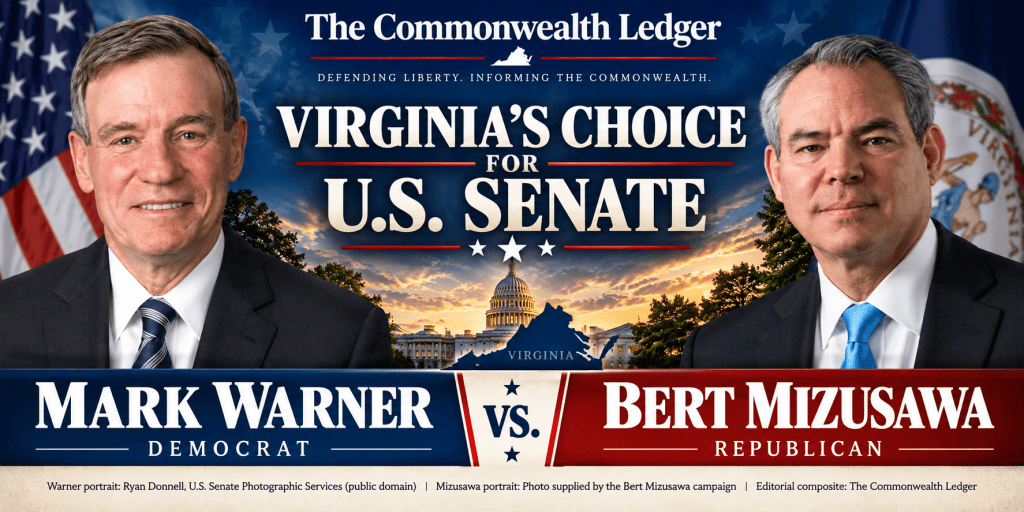
After 18 Years in the Senate, Mark Warner Asks Virginia for Six More. Bert Mizusawa Says It’s Time for a Change.
On November 3, Virginia voters will make a decision that lasts well beyond this election cycle.
A United States senator serves six years.
Democratic Sen. Mark Warner is asking Virginians for a fourth term. Republican Bert Mizusawa is asking them to turn the page.
The choice presents Virginia with two accomplished candidates, but also two substantially different arguments about Washington, government and the direction of the country.
Warner’s case rests heavily on experience, bipartisanship and the influence accumulated during nearly two decades in the Senate.
Mizusawa’s case is that Washington needs a different kind of experience, less career politics and a renewed emphasis on fiscal discipline, national strength and accountability.
Virginia voters must decide which argument they find more compelling.
Mark Warner: A Long Record in Public Office
Warner is no newcomer to Virginia voters.
A businessman who made his fortune in telecommunications and technology, Warner served as governor of Virginia from 2002 to 2006. Virginians first elected him to the U.S. Senate in 2008 and returned him to office in 2014 and 2020.
Today, Warner is Vice Chairman of the Senate Select Committee on Intelligence and serves on the Finance, Banking, Budget, and Rules committees.
His experience matters.
Warner has developed particular influence in intelligence, cybersecurity, technology and national-security policy. His campaign also emphasizes his bipartisan work, infrastructure investment, domestic manufacturing, housing affordability and preparing American workers for the economic effects of artificial intelligence.
Voters considering Warner should evaluate that record on its merits.
But eighteen years in the Senate also raises another legitimate question:
What has that experience produced, and does Virginia want six more years of it?
Bert Mizusawa: A Different Kind of Experience
Mizusawa enters the race without Warner’s years in elected office, but describing him simply as a political newcomer would leave out much of his résumé.
A West Point graduate and retired Army major general, Mizusawa has spent decades in military, legal, national-security and government service.
His career has included military command, service in Afghanistan, work with the Senate Armed Services Committee and senior positions involving the Army and national security.
He also earned a law degree from Harvard Law School and a master’s degree in public policy from Harvard Kennedy School.
Mizusawa argues that those experiences prepared him to serve Virginia without becoming part of Washington’s permanent political class.
His campaign has emphasized federal spending, taxes, affordability, veterans, rural health care, energy production and government accountability. He has also called for banning members of Congress from trading individual stocks.
Washington’s Spending Problem
One of the clearest philosophical divisions between the candidates concerns the size, cost and role of the federal government.
Mizusawa has made fiscal responsibility central to his campaign, arguing that Washington’s spending and debt are ultimately paid for by American families.
Warner presents a different governing philosophy. He points to bipartisan federal investments in infrastructure, technology and domestic manufacturing as evidence that government can make strategic investments that strengthen the economy.
That distinction deserves more attention than campaign slogans.
The question is not whether roads, technology, health care or national defense matter.
The question is how much Washington should spend, where the money should come from and how much debt future generations should be expected to carry.
Energy: An Area of Agreement, and Difference
The candidates are not opposites on every issue.
Both have expressed support for nuclear energy.
Warner is a co-chair of the Senate Advanced Nuclear Caucus and has supported advanced nuclear development as part of a broader energy and technology strategy.
Mizusawa has made nuclear expansion a prominent part of his campaign, arguing that new nuclear generation can provide reliable power while reducing pressure on household energy costs.
Their broader approaches differ, but acknowledging areas of agreement is important.
The Commonwealth Ledger’s job is not to manufacture differences where they do not exist.
Artificial Intelligence and Virginia’s Future
Virginia sits at the center of America’s data-center and artificial-intelligence boom.
Warner has made AI policy a major focus of his campaign and Senate work, proposing federal policies dealing with infrastructure, competition, safety, workers and national security.
Mizusawa approaches technology more broadly through the lenses of economic competitiveness, energy availability and national security.
For Virginia, this debate is not theoretical.
Data centers are transforming communities, increasing electricity demand and raising questions about infrastructure, land use and America’s competition with China.
The next senator will have a voice in those decisions.
Health Care and Rural Virginia
Both campaigns say health-care costs are too high.
Their proposed approaches differ.
Warner emphasizes protecting and expanding health-care coverage, reducing prescription-drug costs and building on existing federal health programs.
Mizusawa says Washington should hold insurance companies accountable and protect funding for rural hospitals.
For Virginians living far from the major population centers of Northern Virginia, Richmond and Hampton Roads, the survival of rural hospitals and access to doctors are not abstract policy questions.
They can determine whether emergency care is ten minutes away or an hour away.
Three Amendments Reveal Another Divide
The Senate candidates will appear on the ballot alongside three proposed amendments to Virginia’s Constitution.
Warner’s campaign supports the amendments dealing with reproductive rights, marriage and restoration of voting rights.
Those questions are examined separately and in detail in this edition of The Commonwealth Ledger.
But Warner’s support for them provides voters with another window into his political philosophy.
The Commonwealth Ledger believes constitutional amendments deserve a particularly high level of scrutiny because ordinary legislation can be changed by a future General Assembly.
Changing the Constitution is different.
The Debate Virginia Isn’t Getting
Virginia voters were supposed to have an unusual opportunity on October 7.
AARP Virginia planned to host its People’s Debate in Richmond, continuing a tradition of televised debates for major statewide races.
Mizusawa accepted the invitation.
Warner’s campaign said the senator could not commit to the date because of what AARP described as an unsettled and expectedly busy official Senate calendar.
AARP canceled the debate.
At the time of the cancellation, no alternative debate between the two candidates had been confirmed.
Whatever a voter’s political affiliation, that is disappointing.
An incumbent senator seeking another six years should face his challenger before Virginia voters, and the challenger should face equally difficult questioning.
Virginia would benefit from seeing both men on the same stage.
THE COMMONWEALTH LEDGER’S VERDICT
Mark Warner is an accomplished Virginian.
Pretending otherwise would undermine the very credibility this publication intends to establish.
He has been a successful businessman, governor and United States senator. He possesses substantial experience in intelligence, technology and national-security policy.
But elections are not lifetime-achievement awards.
They are decisions about the future.
After nearly eighteen years representing Virginia in the Senate, Warner is asking voters for another six, a term that would extend his Senate tenure to twenty-four years.
Bert Mizusawa offers a fundamentally different résumé: soldier, military commander, attorney, national-security official and public servant.
More importantly, he offers a different governing philosophy.
On federal spending, government accountability, taxation, energy, constitutional government and the proper role of Washington, The Commonwealth Ledger believes that change is warranted.
THE COMMONWEALTH LEDGER ENDORSES
BERT MIZUSAWA
FOR UNITED STATES SENATE
That endorsement does not require us to diminish Mark Warner’s accomplishments.
It requires us to answer a more important question:
Who should represent Virginia for the next six years?
Our answer is Bert Mizusawa.
NEXT UP: Virginia’s 11 Congressional Races | Election Overview





Leave a Reply