
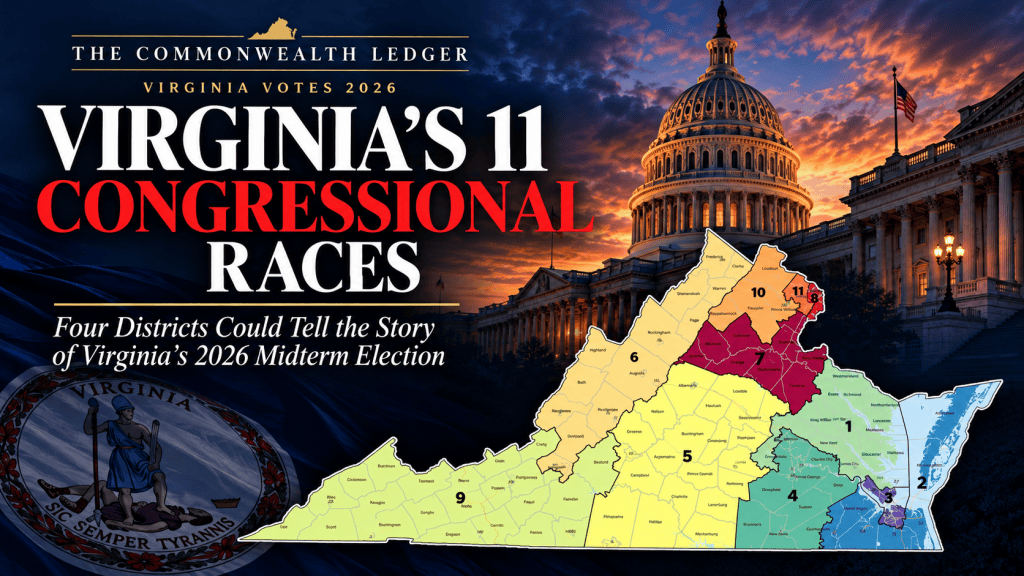
Four Districts Could Tell the Story of Virginia’s 2026 Midterm Election
Virginia will elect all 11 members of its U.S. House delegation on November 3, but the political battle for the Commonwealth is concentrated in a much smaller number of districts.
Most of Virginia’s congressional map remains strongly tilted toward one party or the other. The Cook Political Report currently rates seven of the Commonwealth’s 11 districts as Solid Democratic or Solid Republican.
The exceptions are Virginia’s 1st, 2nd, 5th and 7th Congressional Districts.
Those four races stretch from Hampton Roads and the Northern Neck through the Richmond suburbs and into Central and Northern Virginia. Together, they provide a revealing test of the political environment heading into the final weeks of the 2026 midterms.
Republicans are defending three of them.
Democrats are defending one.
And the results could help determine not simply the makeup of Virginia’s congressional delegation, but control of the United States House of Representatives.
THE VIRGINIA MAP
The Cook Political Report currently rates Virginia’s congressional races:
VA-1: Lean Republican
VA-2: Toss Up
VA-3: Solid Democratic
VA-4: Solid Democratic
VA-5: Likely Republican
VA-6: Solid Republican
VA-7: Likely Democratic
VA-8: Solid Democratic
VA-9: Solid Republican
VA-10: Solid Democratic
VA-11: Solid Democratic
Those ratings leave Republicans favored in four Virginia districts and Democrats favored in six, with the 2nd District sitting squarely in the Toss Up category.
But ratings are not results.
Two districts in particular show why Republicans cannot take traditionally favorable territory for granted in 2026.
VA-1: WITTMAN FACES A SERIOUS CHALLENGE
Republican Rob Wittman has represented Virginia’s 1st Congressional District since winning a 2007 special election and has generally won reelection by comfortable margins.
This year looks different.
Wittman faces Democrat Shannon Taylor, the Henrico County Commonwealth’s Attorney, in a district that stretches from the Richmond suburbs toward the Northern Neck and portions of Hampton Roads.
Cook rates the district Lean Republican and gives it an R+3 Partisan Voting Index.
A Washington Post-Schar School poll conducted September 23-28 and published October 1 found Taylor supported by 50 percent of likely voters and Wittman by 46 percent. The survey included 609 likely voters in the 1st District and had a margin of error of plus or minus 4.5 percentage points.
The four-point difference falls within the poll’s margin of error, meaning the survey should not be read as establishing a clear Taylor lead. It does, however, show a race considerably more competitive than Wittman’s recent elections.
Wittman won reelection in 2024 by approximately 13 percentage points. Donald Trump carried the district by just under five points.
That combination makes VA-1 one of the clearest tests of whether the political environment can overcome an established incumbent’s historical strength in the district.
VA-2: THE REMATCH
If VA-1 is the surprise battleground, VA-2 is the expected one.
Republican Jen Kiggans faces former Democratic congresswoman Elaine Luria in one of Virginia’s most closely divided congressional districts.
Cook rates the race a Toss Up and the district EVEN in its Partisan Voting Index.
Kiggans and Luria are both Navy veterans, both have served in Congress, and both already know what it takes to win in Hampton Roads.
Luria represented the district before Kiggans defeated her in 2022. Four years later, Luria is attempting a return to Congress.
Two independent candidates, J. Matt Baker and Geral D. “Bishop” Staten, are also running.
Unlike districts where one party begins with a substantial structural advantage, VA-2 offers little political cushion to either side. Turnout, persuasion and the national mood could all matter.
For Republicans trying to preserve their House majority, Kiggans is defending one of the most important seats on the Virginia map.
For Democrats, defeating her would represent one of their clearest opportunities for a pickup.
VA-5: McGUIRE STILL FAVORED, BUT THE MARGIN HAS NARROWED
Virginia’s 5th Congressional District remains Republican territory, but the race has attracted renewed attention.
Republican incumbent John McGuire faces former Democratic congressman Tom Perriello, with independent Cooke C. Harvey also on the ballot.
Cook currently rates VA-5 Likely Republican and gives the district an R+6 Partisan Voting Index.
The Washington Post-Schar School poll conducted September 23-28 provides another measure of the race.
McGuire led Perriello among likely voters, 51 percent to 45 percent.
That is a six-point advantage, but it is narrower than recent Republican performances in the district. Both Donald Trump and McGuire carried the district comfortably in 2024.
Perriello brings something most challengers do not: experience representing the district in Congress. He served one term after winning in 2008 before losing in 2010, although today’s 5th District is significantly different after subsequent redistricting.
McGuire remains the favorite according to Cook’s current rating.
The question is whether he wins comfortably or whether VA-5 becomes another indication of a broader Democratic shift in Virginia.
VA-7: VINDMAN DEFENDS DEMOCRATIC TERRITORY
Virginia’s 7th District presents the reverse situation.
Democratic incumbent Eugene Vindman is defending a seat Republicans hope to reclaim. His Republican challenger is Doug Ollivant.
The ballot also includes Libertarian Taner E. Demirci Lopez and independents Alaha Ahrar, Joshua E. Ertle and Randall A. Terry.
Cook rates the district Likely Democratic with a D+2 Partisan Voting Index.
That makes VA-7 competitive enough to watch, but considerably more favorable to Democrats than VA-1 or VA-2 is to Republicans.
For Republicans, a victory here would require overcoming both the district’s current Democratic lean and the advantage Cook currently assigns to Vindman’s party.
For Democrats, holding VA-7 is important precisely because their best path to expanding their Virginia delegation depends on defending the seats they already possess while targeting Republican incumbents elsewhere.
THE OTHER SEVEN
Beyond the four most closely watched contests, the political terrain becomes considerably clearer.
In VA-3, longtime Democratic Rep. Bobby Scott faces Republican Edwin Rivera and independents Makiba A. Gaines and Stephen C. Woll. Cook rates the district Solid Democratic.
In VA-4, Democratic Rep. Jennifer McClellan faces Republican Robert P. “Family Man” Murray Jr.
and independent Joan E. “Andrews” Bell. Cook rates the district Solid Democratic.
In VA-6, Republican Rep. Ben Cline faces Democrat Beth Macy. Cook rates the district Solid Republican.
In VA-8, Democratic Rep. Don Beyer faces Republican Tony Sabio, Libertarian Shelly Arnoldi and independent Tim Sharman. Cook rates the district Solid Democratic.
In VA-9, Republican Rep. Morgan Griffith faces Democrat Joy Powers. Cook rates the district Solid Republican.
In VA-10, Democratic Rep. Suhas Subramanyam faces Republican Dave Beckwith and independent Ahsen Malik. Cook rates the district Solid Democratic.
And in VA-11, Democratic Rep. James Walkinshaw faces Republican Arthur Purves and Green Party candidate Dianne Blais. Cook rates the district Solid Democratic.
Those ratings make major upsets in the seven districts less likely, but voters in each will still decide who represents them in Washington for the next two years.
WHAT VIRGINIA COULD TELL THE COUNTRY
Virginia has increasingly become a state where statewide Democratic strength coexists with sharply different regional political identities.
Northern Virginia remains heavily Democratic. Southwest and much of western Virginia remain overwhelmingly Republican. Hampton Roads, the Richmond suburbs and portions of Central Virginia provide more competitive territory.
That makes the Commonwealth a useful political laboratory for 2026.
If Republicans hold VA-1, VA-2 and VA-5 while making VA-7 competitive, they will have demonstrated considerable resilience in Virginia despite the Democratic opportunities reflected in current polling and race ratings.
If Democrats capture VA-1 or VA-2 while holding VA-7, Virginia’s delegation will move further toward the Democratic Party.
And if Democrats begin seriously threatening VA-5, Republicans will have reason to worry far beyond Virginia.
The Washington Post-Schar School polling already offers evidence of that pressure. Shannon Taylor’s 50-46 showing against Rob Wittman is within the margin of error, but it represents a dramatic tightening from Wittman’s approximately 13-point victory two years ago. John McGuire’s 51-45 advantage over Tom Perriello is more comfortable, but it still points to a competitive contest in a district Cook currently rates Likely Republican.
One poll does not decide an election.
But taken together with Cook’s current ratings, it illustrates the central question facing Virginia Republicans in 2026: Can their candidates hold Republican-leaning districts even as current polling shows Democrats competing in territory that was considerably less competitive two years ago?
For Democrats, the question is equally straightforward: Can favorable opportunities on the Virginia map be converted into actual congressional seats?
On November 3, Virginia will provide 11 answers.
Four of them may matter far beyond the Commonwealth.
NEXT UP: Virginia’s 1st Congressional District | Rob Wittman vs. Shannon Taylor






Leave a Reply