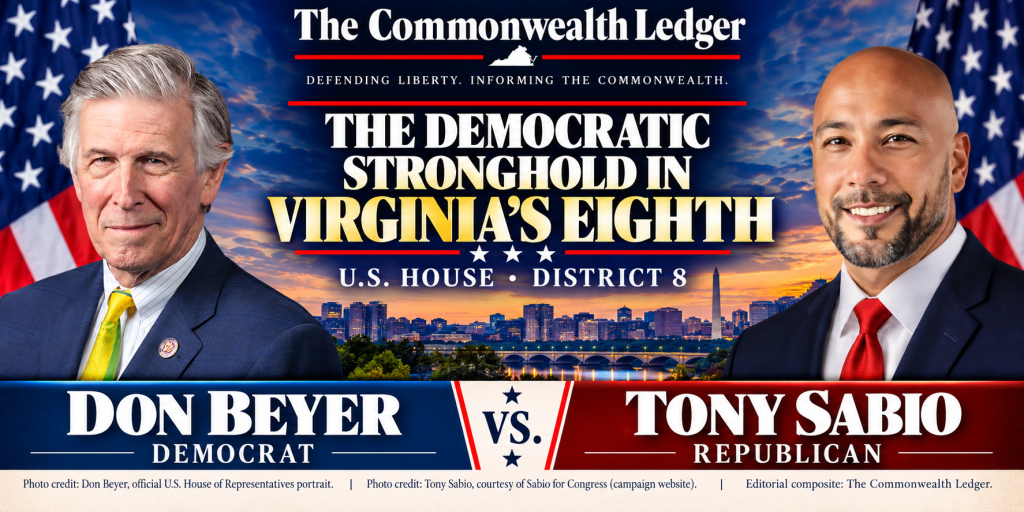
Don Beyer Has Dominated VA-8 for More Than a Decade. Tony Sabio Says Northern Virginia Needs a Different Voice.
By Michael Hevener
There are competitive congressional districts in Virginia.
Virginia’s 8th is not one of them.
At least not on paper.
Democrat Don Beyer has represented the district since 2015, repeatedly winning reelection by overwhelming margins. In 2024, he received approximately 71.7 percent of the vote.
The Cook Political Report rates VA-8 Solid Democratic and gives the district a D+26 Partisan Voting Index.
That makes the 8th the most Democratic congressional district in Virginia.
Republican Tony Sabio is not pretending otherwise.
He enters the general election facing a six-term incumbent, a deeply Democratic electorate and a campaign-finance disparity that would be daunting in a competitive district, much less one where Republicans have struggled for years to approach even 30 percent of the vote.
But elections are not merely exercises in calculating partisan advantage.
They are opportunities to examine the people asking to represent a district, the records they have built and the direction they believe the country should take.
VA-8 gives voters four choices: Don Beyer, the Democratic incumbent; Tony Sabio, the Republican challenger; Shelly Arnoldi, the Libertarian; and Tim Sharman, an independent.
Beyer is overwhelmingly favored to win.
The more interesting question is whether voters believe his record deserves another term, and whether any of his challengers can make a credible argument for a different direction.
THE INCUMBENT
Don Beyer has been part of Virginia public life for decades.
Before entering Congress, he served two terms as lieutenant governor of Virginia, ran unsuccessfully for governor in 1997 and later served as U.S. ambassador to Switzerland and Liechtenstein during the Obama administration.
He was elected to Congress in 2014 and took office in January 2015.
Beyer now represents a dense urban district concentrated in Arlington County, Alexandria, Falls Church and portions of eastern Fairfax County.
It is also one of the country’s most highly educated, affluent and politically Democratic congressional districts.
His political identity fits that constituency.
He supports abortion rights, stronger environmental regulation, expanded health-care protections and a larger federal role in addressing climate change.
He has also become a persistent critic of President Donald Trump.
Asked to identify his top campaign priority in 20 words or fewer, Beyer’s campaign answered: “Lowering prices and fighting Trump’s corruption.”
That response captures much of his 2026 campaign.
Beyer argues that Northern Virginia families are being squeezed by rising costs while the Trump administration and congressional Republicans have pursued tariffs, health-care reductions and a war with Iran that he believes have made those pressures worse.
He is not campaigning as a Democrat seeking distance from his party. He is campaigning as a Democrat who wants his party back in control of the House.
THE CHALLENGER
Tony Sabio is asking one of Virginia’s most Democratic electorates to consider a Republican.
But he is attempting to do it without presenting himself as a conventional partisan warrior.
Sabio has spent much of his adult life in national security and public service.
His background includes military service, the U.S. Secret Service and work as a counterintelligence and counterterrorism officer with the CIA.
His work has taken him to Afghanistan, Iraq and other difficult environments. After leaving government service, he entered private security consulting.
In 2022, Sabio participated in the rescue of a 15-year-old boy from Ukraine following Russia’s invasion.
After the October 7, 2023 Hamas attack on Israel, Sabio conducted work inside Gaza gathering information about possible hostage locations.
That is an unusual résumé for a congressional challenger.
But Sabio’s campaign is not primarily about foreign policy. It is about opportunity.
He describes himself as a Republican who does not view Democrats as enemies and argues that Northern Virginia needs a less partisan approach to affordability, energy, housing, immigration and economic growth.
His campaign’s central theme is what he calls a “Promise for America.”
Northern Virginia has extraordinary wealth, education and opportunity. But families are increasingly struggling to afford living there.
Sabio says government should concentrate less on partisan conflict and more on making it possible for working and middle-class families to build a future.
Whether that message can penetrate a D+26 district is another question. But it gives voters something more substantive to evaluate than a party label.
FOLLOW THE MONEY
The financial contest is not close.
Federal Election Commission reports through July 15 show Beyer’s campaign with approximately $2.13 million in receipts during the 2025-2026 cycle and approximately $839,000 cash on hand.
Sabio reported approximately $21,900 in receipts and approximately $17,900 cash on hand.
Beyer had more than 45 times as much cash available at that reporting point.
Beyer reported approximately $1.55 million in individual contributions and more than $573,000 from other political committees.
Sabio’s campaign reported just over $12,000 in individual contributions, along with a $5,000 party committee contribution and approximately $3,700 in candidate contributions.
Those numbers illustrate the challenge Sabio faces.
Beyer has the financial infrastructure of an established incumbent. Sabio is attempting to build a campaign from the ground up in hostile political territory.
Money does not determine whether a candidate’s ideas are right. It does determine how easily those ideas can be communicated to hundreds of thousands of voters.
The next quarterly FEC reports, covering activity through September 30, are due October 15. We will update these numbers before publication.
THE FEDERAL WORKFORCE
Few congressional districts have a relationship with the federal government quite like VA-8.
Federal workers, contractors and their families are woven into the economic fabric of Arlington, Alexandria, Falls Church and eastern Fairfax.
That makes reductions in the federal workforce more than an abstract debate over the size of government. They affect households, businesses, property values and the regional economy.
Beyer has been an outspoken opponent of the Trump administration’s reductions in the federal workforce. He argues that federal employees have been treated as political targets and that indiscriminate cuts damage both government services and Northern Virginia’s economy.
Sabio takes a different approach.
He acknowledges that federal job losses can hurt families and the regional economy, but argues that Northern Virginia should become less dependent on federal employment.
His answer is economic diversification.
Sabio wants the region to develop a larger private-sector job base, including advanced nuclear energy, manufacturing, cybersecurity, engineering and skilled trades.
He argues that small modular reactor technology could create an entire ecosystem of jobs and manufacturing opportunities.
Beyer wants to defend the federal workforce that already exists. Sabio wants to protect workers while making the regional economy less dependent on Washington.
Those approaches are not necessarily mutually exclusive. But they reflect different assumptions about Northern Virginia’s economic future.
AFFORDABILITY AND HOUSING
Beyer, Sabio and Sharman all identify affordability as a major concern. Their proposed solutions differ.
Beyer argues that Congress should reverse Republican health-care reductions, restore Affordable Care Act tax credits, reclaim congressional authority over tariffs and end the war with Iran.
He sees federal policy as a significant contributor to the rising cost of living and believes federal action can reduce those costs.
Sabio focuses heavily on housing.
His Attainable Housing Plan would encourage construction of starter and workforce homes while reducing federal barriers that he argues increase the time and expense required to build.
He also proposes homeownership incentives for first-time buyers and essential workers, including police officers, firefighters, teachers and medical personnel.
The people who teach children, protect neighborhoods and care for patients should have a realistic opportunity to live in the communities they serve.
Sabio also argues that government cannot simply subsidize its way out of a housing shortage. If the underlying supply remains inadequate, additional subsidies can chase the same limited number of homes.
Independent Tim Sharman also makes affordability central to his campaign.
He emphasizes health-care costs, housing, childcare and tariffs and argues that the two-party system has become too dysfunctional to address those problems effectively.
In one of America’s most expensive regions, affordability is not an ideological abstraction. It is the difference between being able to build a life in Northern Virginia and eventually being priced out of it.
ARTIFICIAL INTELLIGENCE AND THE NEXT ECONOMY
VA-8 may be one of the most appropriate congressional districts in America for a serious debate about artificial intelligence.
Beyer has made AI policy an important part of his work in Congress.
He is a leader in the bipartisan Congressional AI Caucus and is completing graduate-level coursework in machine learning at George Mason University.
He has sponsored or supported legislation dealing with AI transparency, risk management, security flaws and environmental effects.
Beyer argues that Congress cannot wait until AI’s consequences are fully developed before establishing reasonable safeguards.
Sabio is more cautious about regulation.
He uses AI in his own work and describes it as a potentially transformative technology comparable to earlier technological revolutions.
He supports targeted safeguards against fraud, identity theft, malicious deepfakes, exploitation of children and misuse of personal information.
But he warns against regulation that becomes so burdensome that it suppresses American innovation while China and other competitors move ahead.
Sharman places AI even closer to the center of his campaign. He argues that America needs an AI and Robotics Transition Program to prepare workers and communities for the disruption the technology could bring.
The debate is not whether AI is coming. It is already here.
The question is whether Washington can protect Americans from genuine dangers without smothering the innovation that could create the next generation of economic growth.
DATA CENTERS AND ENERGY
Artificial intelligence also leads directly to another Northern Virginia issue: data centers.
The facilities powering America’s digital economy require enormous amounts of electricity, land and infrastructure.
Residents increasingly question whether families and small businesses will be forced to absorb costs created by some of the world’s largest technology companies.
Beyer has expressed concern about the environmental and infrastructure effects of rapid data-center development and has pursued legislation addressing AI’s environmental impact.
Sabio argues that America will need substantially more energy to remain competitive in AI and advanced technology. His preferred long-term answer is advanced nuclear power, particularly small modular reactors.
Sharman argues that local communities should decide whether and where data centers are built and says households and small businesses should not be forced to pay higher electricity and water costs because of massive new facilities.
Libertarian Shelly Arnoldi has taken an even more skeptical approach, arguing that the rapid proliferation of data centers should be halted until their effects are better understood.
All four candidates therefore recognize, to varying degrees, that the growth of AI and data centers carries consequences beyond the technology sector.
America wants the economic benefits of AI. Virginia wants the investment.
But somebody has to generate the electricity, build the transmission infrastructure, provide the water and pay for it. That question will not disappear after Election Day.
HEALTH CARE
Beyer argues that Republican changes to federal health programs threaten access and affordability. He wants to reverse health-care reductions and restore enhanced Affordable Care Act tax credits.
Sabio argues that the system needs reform without abandoning people who depend on it. His broader campaign emphasizes lowering health-care costs while increasing competition and giving families more control.
Sharman goes further in a different direction, proposing automatic enrollment in health insurance and structural reforms aimed at reducing the overall cost of American health care.
The disagreement again comes down to the role of government.
How much should Washington subsidize? How much should it regulate? How much competition can actually reduce prices?
And how does the country protect people with serious medical needs without allowing health-care spending to grow indefinitely?
Those questions are more difficult than campaign slogans from either party often acknowledge.
IMMIGRATION
Sabio’s immigration position is more nuanced than the standard partisan shorthand.
He supports strong border enforcement, mandatory E-Verify and removal of dangerous criminals.
He does not support citizenship for people who entered the country illegally.
But he also supports a work-based legal status for qualifying immigrants already in the country who register, pass background checks, work or attend school, pay taxes, obey the law and provide for their own health care.
Sabio describes America as both a nation of laws and a nation of immigrants.
Sharman, himself an immigrant, argues for a system with a secure back door and a welcoming front door.
He supports ending illegal immigration while creating a path to legal status and eventually citizenship for people who have established lives in the United States and obeyed the law.
Beyer supports comprehensive immigration reform and has sharply criticized the Trump administration’s enforcement policies.
The disagreement is not simply whether America should have immigration.
It is about enforcement, legal status, citizenship and whether Congress can finally construct a system that distinguishes clearly between legal immigration and illegal entry while recognizing the economic and human realities of millions of people already living here.
IRAN AND THE POWER TO GO TO WAR
Foreign policy is particularly relevant in this race because Sabio has spent much of his career dealing directly with national-security threats.
Beyer has become an outspoken critic of the current war with Iran.
In September, he voted for a War Powers resolution directing the president to remove U.S. armed forces from hostilities with Iran.
He argues that Congress must reclaim its constitutional role in decisions involving war and that the conflict has imposed human and economic costs on Americans.
Sabio approaches national security from the perspective of someone who has worked in counterterrorism and intelligence environments. His campaign emphasizes strength, preparedness and protecting American interests.
But experience in national security should invite harder questions, not fewer of them.
When should the United States use military force? What constitutes an imminent threat? How long may a president continue hostilities without explicit congressional authorization?
And when American lives are placed at risk, what responsibility belongs to Congress?
The Constitution gives Congress substantial authority over war. That responsibility should not disappear simply because the president exercising military power belongs to the same political party as members of Congress.
ABORTION AND VIRGINIA’S CONSTITUTIONAL AMENDMENTS
Virginia voters will decide three proposed constitutional amendments on the same ballot as this congressional race.
Those questions are state constitutional matters, not federal legislation. But the candidates’ positions can still provide voters with another measure of their governing philosophies.
The Commonwealth Ledger will examine each amendment separately in this Election Guide.
Our position is no on all three.
Beyer has long supported abortion rights and has a record firmly on the abortion-rights side of the national debate.
The 2026 public-media candidate questionnaire also asked candidates about Virginia’s three constitutional amendments.
Where a candidate’s position on a particular amendment is clearly documented, The Commonwealth Ledger will report it.
Where it is not, we will not infer an answer from party affiliation.
That standard applies equally to Beyer, Sabio, Arnoldi and Sharman.
THE LIBERTARIAN
Shelly Arnoldi gives voters another alternative.
Arnoldi is a U.S. Navy veteran and licensed professional engineer with more than 27 years of experience managing facilities and construction projects involving the military, Department of Defense schools, the Smithsonian and the National Gallery of Art.
She served 10 years in the Navy Civil Engineer Corps and later continued working in engineering and facilities management.
Her campaign emphasizes parental rights, lower taxes, government accountability, border security, term limits and limiting federal power.
She has also taken a skeptical position on the rapid expansion of data centers and argues that government has moved too far from the citizens it is supposed to serve.
Her candidacy is unlikely to receive the financial attention available to Beyer. But ballot access matters.
A voter dissatisfied with both major parties has an opportunity to cast a vote for a candidate whose philosophy places individual liberty and smaller government at the center of the campaign.
Arnoldi’s presence also complicates Sabio’s already difficult task.
In a district where Republicans begin with a relatively small share of the electorate, losing even a modest number of limited-government voters to a Libertarian candidate makes the arithmetic harder.
THE INDEPENDENT
Tim Sharman is running a more substantial independent campaign than voters might expect.
An Oxford-educated entrepreneur and CEO of TrulyUs, Sharman argues that America’s two-party system has become an obstacle to solving problems.
An immigrant who later became an American citizen, Sharman brings his own perspective to the country’s immigration debate.
His campaign focuses heavily on affordability, health care, AI, robotics and government functionality.
Sharman criticizes the way both parties have handled shutdowns and federal workforce policy.
He does not argue simply that Democrats are wrong or Republicans are wrong. He argues that the structure of partisan politics itself increasingly prevents government from functioning effectively.
That message may resonate with voters exhausted by both parties.
But independent candidates face a structural challenge. Being dissatisfied with Democrats and Republicans is common. Convincing enough voters to abandon both parties simultaneously is considerably harder.
A 71-PERCENT INCUMBENT
The central fact of this race cannot be ignored.
Don Beyer received approximately 71.7 percent of the vote in 2024. He received approximately 73.5 percent in 2022. He received approximately 75.8 percent in 2020.
Those are not the results of a marginal district. They are the results of a Democratic stronghold.
Tony Sabio therefore faces a political task very different from Republicans running in VA-1, VA-2, VA-5, VA-6 or even VA-7.
He is not merely trying to win undecided voters. He has to persuade a significant number of people who routinely vote Democratic to consider voting Republican.
That requires more than criticizing Beyer. It requires making voters comfortable with Sabio himself.
His emphasis on bipartisanship appears designed for precisely that purpose.
Sabio says Democrats are not his enemy.
In VA-8, that cannot merely be campaign rhetoric.
If a Republican is ever going to become competitive here, he has to persuade Democratic and independent voters that disagreement does not mean hostility and that crossing party lines does not require abandoning their values.
THE LEDGER’S ANALYSIS
Don Beyer has advantages that extend far beyond campaign money.
He represents a district whose political philosophy largely aligns with his own. He has decades of public experience. He has developed expertise in areas including taxation, climate policy and artificial intelligence.
And voters have repeatedly returned him to Congress by overwhelming margins.
Those facts deserve recognition even from voters who disagree with him.
But electoral security can create its own problem.
Representatives in safe districts should not become insulated from meaningful scrutiny simply because the opposing party struggles to compete.
Beyer’s positions on federal spending, health care, abortion, energy and the size and role of government deserve the same examination as those of an incumbent in a swing district.
So does his increasingly confrontational relationship with the Trump administration.
Opposition can be principled. It can also become reflexive.
The responsibility of a member of Congress is not to support or oppose a president automatically. It is to judge policies, spending and executive actions on their merits and within the Constitution.
Sabio presents voters with a different governing philosophy.
He emphasizes private-sector growth, energy production, attainable housing, border enforcement, national security and reducing Northern Virginia’s economic dependence on the federal government.
His background in military service, the Secret Service, intelligence and private security gives him experience unusual for a first-time congressional candidate.
But Sabio also has weaknesses.
His campaign is dramatically underfunded compared with Beyer’s. He has never held elected office. And many of his proposals have never been tested through the legislative process.
A compelling biography is not the same thing as a congressional record.
VA-8 voters should demand details from him just as they should demand accountability from Beyer.
THE LEDGER’S CHOICE
The Commonwealth Ledger approaches endorsements with a simple principle:
A party label is not enough.
In Virginia’s 8th District, that principle matters.
Don Beyer is an experienced public servant who has represented his constituents for more than a decade and has developed serious expertise on several complicated policy issues.
We disagree with much of his governing philosophy.
But disagreement should not prevent us from acknowledging his experience or the confidence voters in this district have repeatedly placed in him.
Tony Sabio offers a substantially different direction.
His emphasis on economic opportunity, attainable housing, energy abundance, border security, national security and a less partisan political culture more closely reflects the direction The Commonwealth Ledger believes Congress should take.
His argument that Northern Virginia should diversify its economy rather than depend so heavily on federal employment deserves serious consideration.
So does his belief that Republicans should be willing to work with Democrats rather than treat political disagreement as personal hostility.
The fact that VA-8 is overwhelmingly Democratic does not make competition meaningless.
Quite the opposite.
Safe districts need credible challengers precisely because incumbents should never be entitled to their seats.
Sabio faces extraordinarily difficult political odds.
That is not a reason to withhold an endorsement if we believe he is the stronger candidate. It is a reason to judge him on the same standard we would use in a competitive district.
On balance, Sabio’s approach to economic opportunity, energy, housing, immigration, national security and the proper scope of federal power more closely reflects the direction we believe Congress should take.
The Commonwealth Ledger believes VA-8 would benefit from a different voice in Washington.
For Virginia’s 8th Congressional District, our choice is Tony Sabio.